Most of the organic search traffic an ecommerce store gets doesn’t land on a blog post. It lands directly on a product or collection page. That means the specific words in your titles, descriptions, and image alt text carry more weight for sales than almost anything else you’ll write for your store.
Our How to Set Up a Shopify Store in 2026 guide touches on alt text as part of launch prep, and our Best Shopify Themes for 2026 guide covers how theme speed affects this too. This post goes deeper into getting your product pages themselves right.
Key Takeaways
- Product and collection pages, not blog posts, drive most ecommerce organic traffic.
- Never use the manufacturer’s product description as-is. Duplicate content hurts every page that uses it.
- Titles should lead with the specific product name, not stuffed keywords.
- Alt text is both an accessibility requirement and a genuine SEO signal, not a formality.
- Fast pages and clear descriptions help SEO and conversion at the same time.
Product Titles That Actually Rank
Lead with the specific, distinguishing details a shopper would search for. Something like “Organic Cotton Crew Socks, 3-Pack, Charcoal Grey” tells Google and a shopper exactly what the product is in one glance. A vague title like “Comfy Socks” tells neither.
- Front-load the most important, specific words. Search results often cut off titles after roughly 60 characters.
- Include the distinguishing detail, whether that’s material, size, color, or use case, especially if you sell variants of a similar product.
- Avoid repeating the same generic keyword across every product title. Google treats near-duplicate titles across your own catalog as a weak signal, not a strong one.
Writing Product Descriptions Google Can Actually Use
If you sell a product other stores also carry, don’t copy the manufacturer’s description straight onto your page. Dozens of other stores are already using that exact text, and Google has no reason to treat your page as more relevant than any of theirs.
Write your own description instead, and open with what the product actually does or solves before listing specs. This is the same principle that makes any web content easier to read: state the point first, then back it up.
- Lead with the core benefit or use case in the first sentence.
- Follow with the specific details: materials, dimensions, care instructions, what’s included.
- Use plain, factual language. Skip words like “amazing” or “game-changing.” Shoppers and search engines both treat those as filler, not information.
How Important Is Image Alt Text for Product SEO?
Very. Alt text is a short written description of an image, and it’s one of the clearest, most overlooked SEO signals on a product page.
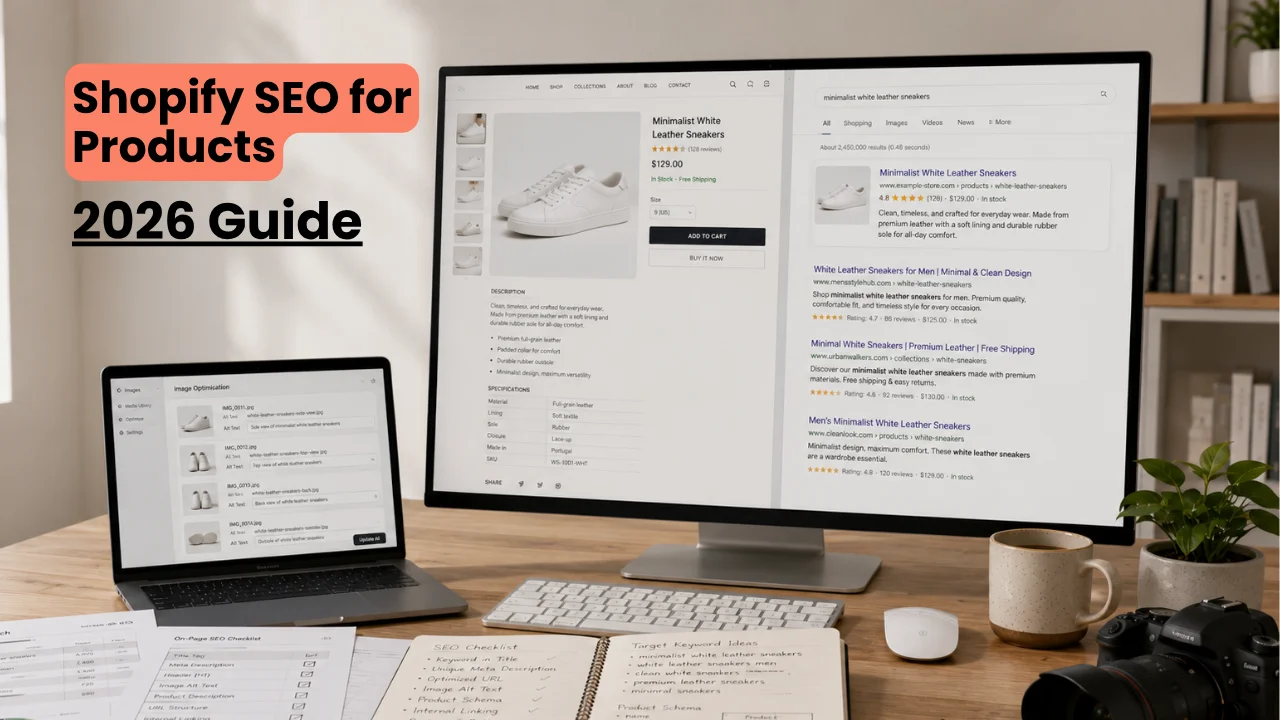
Write alt text that describes what’s actually in the photo, specifically. “Charcoal grey cotton crew socks folded on a wood table” tells Google far more than “sock1.jpg” or nothing at all. This also ties directly into product photography consistency, which our Shopify Branding Guide covers from the branding side.
Structured Data and Rich Snippets
Most Shopify themes automatically output basic product structured data, like price and availability, which is what lets Google show extra details directly in search results, like a price or star rating next to your listing. If you’re using a review app, check that it’s actually feeding star ratings into this data. A missing or broken review integration means you lose out on a rich snippet you’re otherwise entitled to.
Page Speed and Product SEO
Google doesn’t rank pages directly on a speed score, but slow pages produce worse numbers on the things Google does track: how long someone stays, and whether they bounce back to the search results. A bloated product page with unoptimized images undercuts everything else you do right on that page.
Your theme sets the ceiling for how fast your product pages can load. See our Best Shopify Themes for 2026 guide for which themes hold up once you’ve added real product images, not just the demo.
Common Product Page SEO Mistakes
- Using the manufacturer’s stock description word for word
- Leaving alt text blank or filled with the image filename
- Writing the same generic title format across every product with only one word changed
- Stuffing keywords into a description instead of writing naturally
- Ignoring page speed until after launch, when it’s harder to fix
How This Connects to Conversion, Not Just Traffic
Good SEO gets someone to your product page. What happens next is a conversion question, not an SEO one, but the two overlap more than most guides admit. Clear, specific, non-hyped writing is exactly what performs best in both.
Frequently Asked Questions
Does Shopify have good SEO by default?
Shopify handles the technical basics well: clean site structure, automatic sitemaps, and fast hosting. What it doesn’t do for you is write unique titles, descriptions, and alt text. That part is still on you.
Should I rewrite manufacturer product descriptions?
Yes, if any other store is likely selling the same product with the same description. Even a short rewrite in your own words is enough to stop it from being flagged as duplicate content.
How long does it take for Shopify SEO changes to show results?
Typically a few weeks to a few months, depending on how competitive your product category is. Product SEO is a compounding effort, not an instant fix.
Do I need an app for Shopify SEO?
Not to get the basics right. Titles, descriptions, and alt text just need to be written well. Apps become useful for more advanced tasks, like bulk-editing metadata across a large catalog.
When It Makes Sense to Get Professional Help
Writing unique, well-structured product copy across a catalog of 50, 200, or 1,000 SKUs is a real time cost, and it’s the kind of work that’s easy to keep postponing.
If you want your product pages optimized properly without doing it product by product yourself, a professional service can handle it end to end.
Get Your Shopify Product Pages Optimized
Published by Logicade | Full-Service Digital Marketing and Web Development Agency
If you found this guide useful and want your product pages optimized by specialists who understand both Shopify SEO and the conversion side that turns traffic into sales, visit our Shopify Product Page Optimization Service or get in touch for a free consultation.