Introduction
You did everything right. The keyword research, the content, the technical fixes, the backlinks. Your page finally sits in position one on Google. Then you open Search Console and the clicks are lower than they were last year.
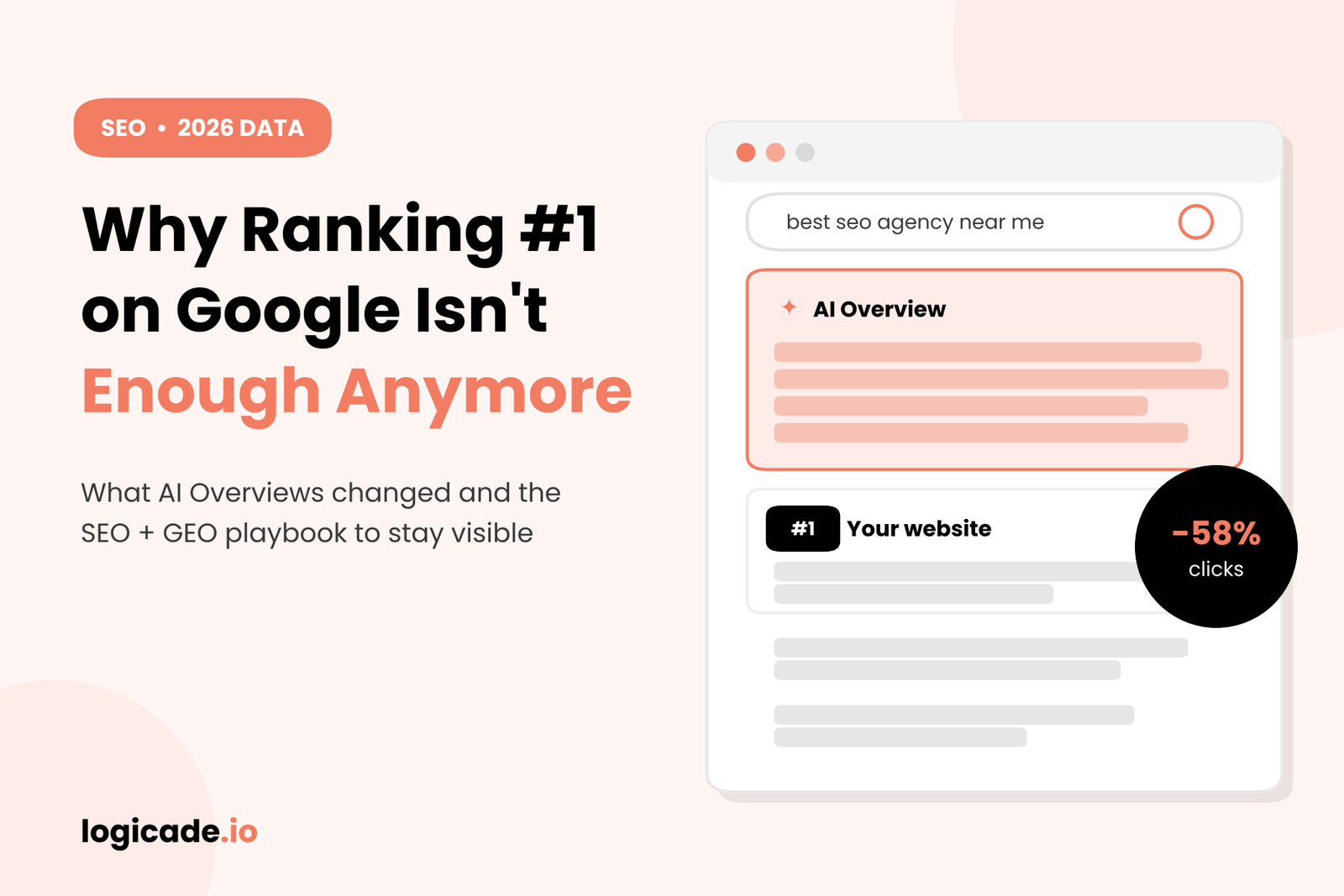
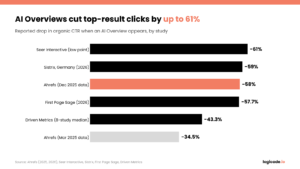
You are not imagining it. In 2026, ranking #1 on Google no longer guarantees traffic, and it no longer guarantees that your brand appears where buyers actually get their answers. According to Ahrefs, when an AI Overview appears, the top-ranking page now gets 58% fewer clicks on average.
This guide breaks down what changed, what the latest data says, and the practical SEO and GEO (generative engine optimization) playbook we use at Logicade to keep clients visible on Google, in AI Overviews, and inside tools like ChatGPT.
Quick answer: Ranking #1 isn’t enough anymore because AI answers now sit above the organic results and satisfy many searches without a click. AI tools also cite pages based on brand authority and answer quality, not just rank. To stay visible, you need strong SEO plus content and brand signals that AI engines trust and quote.
What Changed: Search Now Answers Instead of Linking
For 20 years, search worked like a directory. You typed a query, Google showed ten blue links, and the top link won most of the clicks. That model is breaking because search engines now write the answer themselves.
Three shifts are driving this:
- AI Overviews and AI Mode. Google summarizes the answer at the top of the page, often pushing the #1 organic result below the fold. AI Overviews now reach over 2.5 billion monthly users, and AI Mode has passed 1 billion.
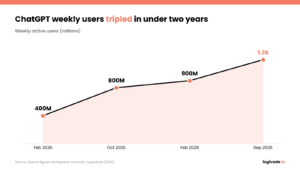
- AI assistants as search engines. People ask ChatGPT, Gemini, Perplexity and Claude for recommendations, comparisons and how-tos. OpenAI reported 2 billion ChatGPT weekly active users in September 2026, triple the roughly 400 million it reported in early 2025.
- Answers instead of journeys. A buyer who once visited five sites to compare options can now get a summarized shortlist in one response. If your brand is not in that answer, you are not in the consideration set.
Google is not going anywhere. It still handles about 91% of search engine referrals worldwide. The point is that the same Google results page now sends fewer clicks, while a second discovery channel grows alongside it.
The Data: How Much Traffic Is the #1 Spot Really Losing?
The #1 position is losing roughly 40% to 60% of its clicks on searches where an AI Overview appears. Different studies use different methods, but every major one points in the same direction.
Position one takes the biggest hit
A 2026 report from First Page Sage found the top result’s click-through rate falls from 27.4% to 11.6% when an AI Overview is shown, a 57.7% relative drop. Ahrefs measured a 58% drop across 300,000 keywords, up from 34.5% just eight months earlier. Its data shows position two lost about half its clicks and even position ten lost nearly 20%.
A Driven Metrics review of eight studies put the typical penalty at about 40%, with a median of 43.3%. Whichever number you use, rank alone no longer predicts traffic.
Most searchers never click at all
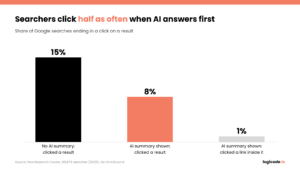
In a Pew Research Center study of 68,879 real Google searches, users clicked a traditional result only 8% of the time when an AI Overview appeared, compared with 15% without one. Only 1% clicked a link inside the AI Overview itself.
First Page Sage reports the zero-click rate rises from 62.9% to 82.7% when an AI Overview is present. In other words, more than four out of five of those searches end on Google.
Some industries are hit much harder than others
Informational content suffers most, because an AI summary can fully answer a general question. Driven Metrics’ randomized data shows AI Overviews trigger on 53% of informational queries, but only 15% of navigational and 6% of transactional ones.
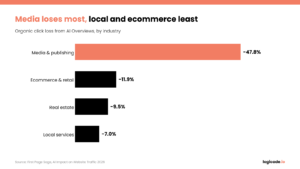
That explains the industry gap. First Page Sage found media and publishing lost 47.8% of organic clicks, while ecommerce and retail lost 11.9%, real estate 9.5% and local services 7.0%. Searches that need a purchase, booking or visit still need a click.
For local businesses and online stores, this is good news, but only if your local SEO and ecommerce SEO are strong enough to capture the clicks that remain.
Ranking and Being Cited Are Now Two Different Things
In 2026, most pages cited in Google’s AI Overviews do not rank in the top 10 for that query. That is the single biggest reason ranking #1 is no longer the finish line.
An Ahrefs analysis of 863,000 keywords found that only about 37% of cited pages rank in the organic top 10. Around 26% rank between positions 11 and 100, and roughly 37% do not rank in the top 100 at all.
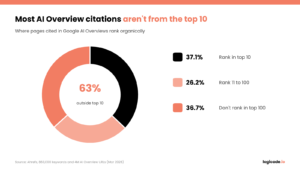
This is a fast change. In mid-2025, about 76% of AI Overview citations came from top-10 pages. Eight months later, that share had fallen to 38%. Rankings used to be a reliable proxy for AI visibility. They no longer are.
Other AI platforms diverge even further. A multi-source analysis compiled by Loganix found ChatGPT citations overlap with Google’s top 10 only 6.5% of the time. In Ahrefs’ study of 75,000 brands, 26% had zero AI Overview mentions, including many that rank well.
Why the gap? Google breaks a query into several sub-questions and cites the pages that answer each one best. A page can rank #1 for the head term and still lose the citation to a clearer answer on page three.
What AI Engines Actually Reward
AI engines reward brands that are widely mentioned, clearly explained and easy to quote. Rankings still help, but they are one signal among several.
1. Brand mentions beat backlinks
In Ahrefs’ 75,000-brand study, branded web mentions showed a 0.664 correlation with AI visibility, about three times stronger than backlinks at 0.218. Brands in the top quartile for mentions earned more than 10 times the AI Overview mentions of the next quartile. Domain authority showed a near-zero relationship.
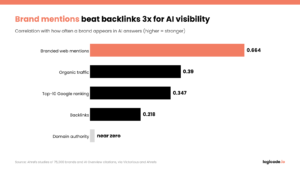
A mention does not need a link to count. Reviews, press coverage, podcast appearances, industry roundups, forum discussions and social posts all teach AI models that your brand belongs in the answer.
2. Clear, extractable answers
AI systems pull short passages, not whole pages. Pages that open each section with a direct answer under a clear heading are easier to cite. Length is not the goal: 53.4% of cited pages were under 1,000 words.
3. Coverage of the sub-questions
Because Google splits queries into sub-questions, a page that covers the follow-ups (cost, comparison, pros and cons, how-to) has more chances to be cited. Good keyword research and strategy now means mapping questions, not just head terms.
4. Video and multi-platform presence
YouTube has become a major citation source. Among AI Overview citations from pages outside the top 100, 18.2% were YouTube URLs. If your expertise only lives in blog posts, you are missing a channel AI engines read. Professional YouTube video editing and consistent social media management both feed this signal.
5. Technical health and structured data
AI crawlers still need to access, render and understand your pages. Fast load times, clean HTML, and schema markup (Organization, FAQPage, HowTo, Product, LocalBusiness) make your content easier to parse and attribute.
SEO vs GEO vs AEO: You Need All Three
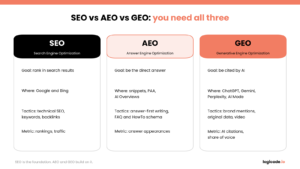
SEO, GEO and AEO are not competing strategies. They are layers of the same goal: being found and chosen wherever people search. SEO still builds the foundation that the other two depend on.
| SEO | AEO | GEO | |
| Full name | Search engine optimization | Answer engine optimization | Generative engine optimization |
| Main goal | Rank pages in search results | Be the direct answer in snippets, voice and AI summaries | Be cited and recommended in AI-generated responses |
| Where it shows up | Google and Bing organic results | Featured snippets, People Also Ask, AI Overviews | ChatGPT, Gemini, Perplexity, Claude, AI Mode |
| Key tactics | Technical SEO, keywords, on-page, backlinks | Answer-first writing, question research, FAQ and HowTo schema | Brand mentions, original data, entity clarity, multi-platform presence |
| Success metric | Rankings, organic traffic | Snippet and AI Overview appearances | AI citations, share of voice in AI answers |
The terms overlap, and many marketers use AEO and GEO interchangeably. In search demand, GEO is the more popular label: global searches for “generative engine optimization” reached 54.3K in January 2026, versus 30K for “answer engine optimization”.
The Upside: Fewer Clicks, Better Clicks
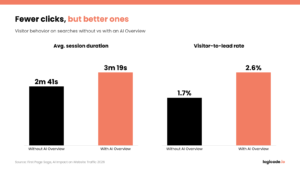
The visitors who still click after reading an AI answer are better qualified, and they convert more often. That changes how you should judge SEO performance.
First Page Sage found that post-AI Overview visitors spend 23.6% longer on site (3m 19s vs 2m 41s) and convert to leads at 2.6% compared with 1.7%. On US retail sites, visitors referred by AI platforms converted at a 60% higher rate than other traffic in July 2026. Being cited also helps clicks: Seer Interactive found organic CTR was about 35% higher for brands cited inside the AI Overview.
This is why raw traffic is a weaker KPI than it used to be. A smaller stream of buyers who already understand your offer is worth more, as long as your landing pages are built to convert them. Pair your SEO with conversion rate optimization so each remaining click counts.
The 2026 Playbook: How to Stay Visible Beyond Rankings
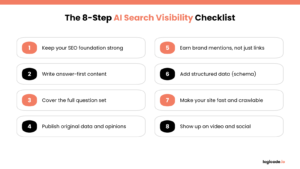
These eight steps are the same framework we use with Logicade clients. Start with the foundation, then build the signals AI engines trust.
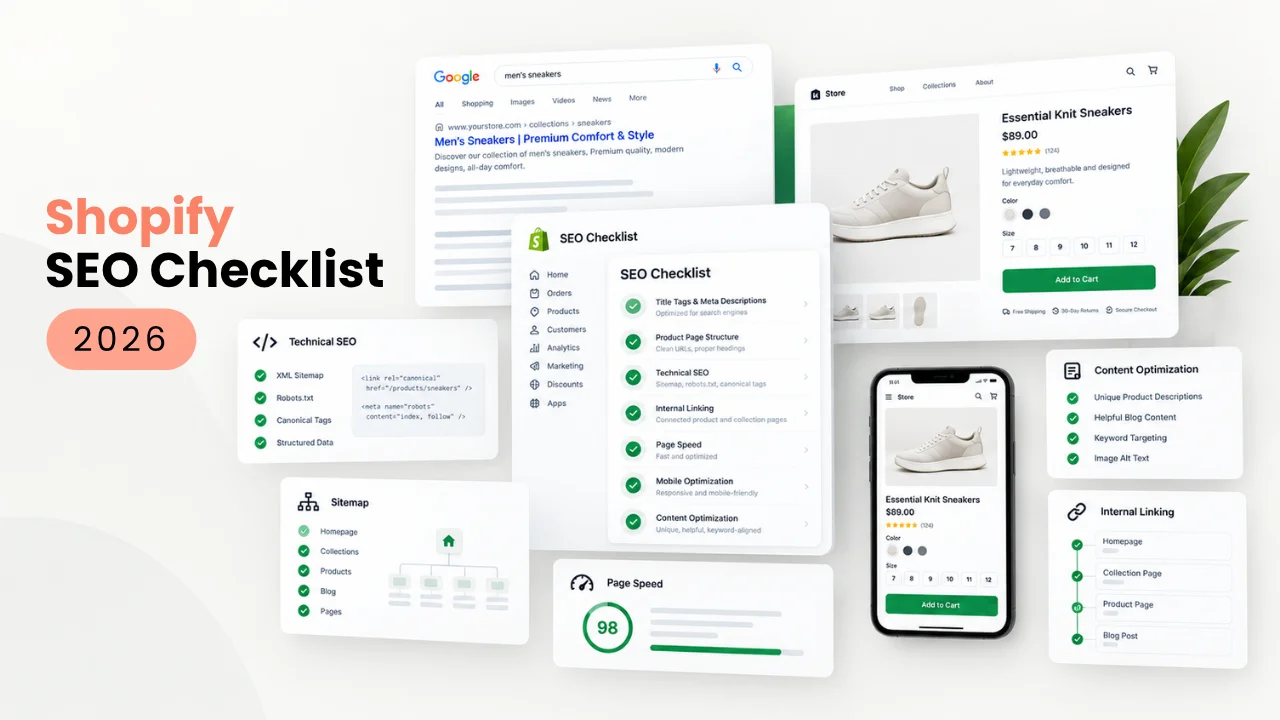
- Keep your SEO foundation strong. Rankings still feed AI citations, and Google still drives the majority of search traffic. Start with a full SEO audit covering crawlability, indexing, site structure and content gaps. Our SEO Checklist 2026 is a good self-check.
- Write answer-first content. Open every key section with a one or two sentence answer, then expand. Use question-based H2s and H3s that mirror how people ask.
- Cover the full question set. Map the follow-up questions around each topic (cost, comparisons, alternatives, how-to, problems). Our content marketing and blog content teams build topic clusters around these sub-questions.
- Publish original data and opinions. AI engines prefer sources with something unique to say. Share client results, surveys, benchmarks and expert commentary that others will reference.
- Earn brand mentions, not just links. Pursue reviews, PR, guest appearances, industry directories and community discussions. Track who is mentioned for your topics with competitor analysis.
- Add structured data. Implement Organization, FAQPage, HowTo, Product and LocalBusiness schema where relevant. On WordPress this is straightforward with the right setup, and our WordPress development team can build custom schema into your templates.
- Make your site fast and crawlable. Slow, script-heavy pages are harder for both users and AI crawlers. Check your speed optimization and Core Web Vitals, and make sure robots.txt does not block AI crawlers you want to reach.
- Show up on video and social. Turn your best articles into short videos and YouTube explainers. Repurpose key stats into social posts so your brand appears across more of the sources AI models read.
This is ongoing work, not a one-time project. AI citation patterns shift month to month, which is why monthly SEO maintenance now includes refreshing content and checking AI visibility, not just rankings.
How to Measure Visibility Beyond Rankings
If rankings no longer tell the full story, you need a wider scorecard. Track these five metrics alongside your usual SEO reports:
- AI citations and mentions. How often your brand appears in AI Overviews, ChatGPT, Gemini and Perplexity for your priority questions. Tools like Ahrefs Brand Radar, Semrush and dedicated AI visibility trackers can monitor this, or you can run a manual prompt check each month.
- Share of voice in AI answers. Of the brands mentioned for your core topics, what percentage of mentions are yours versus competitors.
- AI referral traffic. In GA4, create a channel group for referrals from chatgpt.com, gemini.google.com, perplexity.ai, copilot.microsoft.com and claude.ai.
- Branded search volume. When AI tools mention you, people often search your brand name next. Rising branded search is a strong indirect signal.
- Conversion rate by channel. Fewer but better clicks should show up as higher conversion rates, not just lower sessions.
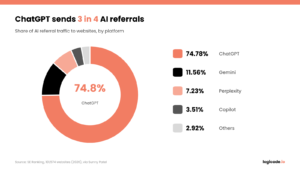
AI referrals are still small but growing fast. They now make up about 1.08% of website traffic across 10 industries, and ChatGPT sends the largest share. According to SE Ranking’s study of 101,574 websites, ChatGPT drives 74.78% of AI referral traffic, followed by Gemini at 11.56% and Perplexity at 7.23%.
A simple way to start: ask “how did you hear about us?” on every lead form and add “ChatGPT or another AI tool” as an option. Self-reported data often reveals AI influence that analytics misses.
Frequently Asked Questions
Does SEO still matter in 2026?
Yes. Google still handles about 91% of search engine referrals, and pages that rank well are more likely to be cited by AI. SEO is now the foundation, with GEO and AEO built on top of it.
Why is my organic traffic dropping if my rankings are stable?
The most common cause is AI Overviews. When an AI summary appears above your result, studies show the top position can lose 40% to 58% of its clicks, even though the ranking itself has not changed.
What is generative engine optimization (GEO)?
GEO is the practice of making your brand and content more likely to be cited or recommended in AI-generated answers from tools like ChatGPT, Gemini, Perplexity and Google AI Overviews.
How do I get my website cited in Google AI Overviews?
Write clear, answer-first content, cover the related sub-questions, add structured data, keep your site fast and crawlable, and build brand mentions across trusted third-party sites.
What is a zero-click search?
A zero-click search is one where the user gets their answer on the results page and does not click any website. When an AI Overview is shown, more than 80% of searches can end this way.
How can I tell if AI tools are sending traffic to my site?
In Google Analytics 4, filter referral traffic for sources such as chatgpt.com, perplexity.ai and gemini.google.com. Pair this with a “how did you hear about us?” question on your forms.
Conclusion: Rank, Get Cited, Get Chosen
Ranking #1 on Google is still valuable, but it is no longer the finish line. The brands that win in 2026 rank well, get cited in AI answers, and convert the smaller, smarter stream of visitors who still click.
The good news is that the work overlaps. Strong technical SEO, answer-first content, real brand authority and a fast website help you in Google and in AI search at the same time.
At Logicade, our SEO services combine traditional SEO with AI search visibility, so your brand shows up wherever your customers are looking. Not sure where you stand? Start with a free SEO audit, or book a free consultation and we will map out your next steps.